#include <ThetaImplicitEM.H>
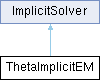
Public Member Functions | |
| ThetaImplicitEM ()=default | |
| ~ThetaImplicitEM () override=default | |
| ThetaImplicitEM (const ThetaImplicitEM &)=delete | |
| ThetaImplicitEM & | operator= (const ThetaImplicitEM &)=delete |
| ThetaImplicitEM (ThetaImplicitEM &&)=delete | |
| ThetaImplicitEM & | operator= (ThetaImplicitEM &&)=delete |
| void | Define (WarpX *a_WarpX) override |
| Read user-provided parameters that control the implicit solver. Allocate internal arrays for intermediate field values needed by the solver. | |
| void | PrintParameters () const override |
| void | OneStep (amrex::Real start_time, amrex::Real a_dt, int a_step) override |
| Advances the simulation one time step. | |
| void | ComputeRHS (WarpXSolverVec &a_RHS, const WarpXSolverVec &a_E, amrex::Real start_time, int a_nl_iter, bool a_from_jacobian) override |
| Computes the RHS of the equation corresponding to the specified implicit algorithm. The discrete equations corresponding to numerical integration of ODEs are often written in the form U = b + RHS(U), where U is the variable to be solved for (e.g., the solution at the next time step), b is a constant (i.e., the solution from the previous time step), and RHS(U) is the right-hand-side of the equation. Iterative solvers, such as Picard and Newton, and higher-order Runge-Kutta methods, need to compute RHS(U) multiple times for different values of U. Thus, a routine that returns this value is needed. e.g., Ebar - E^n = cvac^2*0.5*dt*(curl(Bbar) - mu0*Jbar(Ebar,Bbar)) Here, U = Ebar, b = E^n, and the expression on the right is RHS(U). | |
| virtual amrex::Real | GetThetaForPC () const override |
 Public Member Functions inherited from ImplicitSolver Public Member Functions inherited from ImplicitSolver | |
| ImplicitSolver ()=default | |
| virtual | ~ImplicitSolver ()=default |
| ImplicitSolver (const ImplicitSolver &)=delete | |
| ImplicitSolver & | operator= (const ImplicitSolver &)=delete |
| ImplicitSolver (ImplicitSolver &&)=delete | |
| ImplicitSolver & | operator= (ImplicitSolver &&)=delete |
| bool | IsDefined () const |
| void | CreateParticleAttributes () const |
| bool | DoParticleSuborbits () |
| int | numAMRLevels () const |
| const amrex::Geometry & | GetGeometry (int) const |
| const amrex::Array< FieldBoundaryType, 3 > & | GetFieldBoundaryLo () const |
| const amrex::Array< FieldBoundaryType, 3 > & | GetFieldBoundaryHi () const |
| amrex::Array< amrex::LinOpBCType, 3 > | GetLinOpBCLo () const |
| amrex::Array< amrex::LinOpBCType, 3 > | GetLinOpBCHi () const |
| const amrex::Vector< amrex::Array< amrex::MultiFab *, 3 > > * | GetMassMatricesCoeff () const |
| Return pointer to MultiFab array for mass matrix. | |
| void | ComputeJfromMassMatrices (const bool a_J_from_MM_only) |
Private Member Functions | |
| void | UpdateWarpXFields (const WarpXSolverVec &a_E, amrex::Real start_time) |
| Update the E and B fields owned by WarpX. | |
| void | FinishFieldUpdate (amrex::Real end_time) |
| Nonlinear solver is for the time-centered values of E. After the solver, need to use m_E and m_Eold to compute E^{n+1}. | |
Private Attributes | |
| WarpXSolverVec | m_E |
| Solver vectors to be used in the nonlinear solver to solve for the electric field E. The main logic for determining which variables should be WarpXSolverVec type is that it must have the same size and have the same centering of the data as the variable being solved for, which is E here. For example, if using a Yee grid then a container for curlB could be a WarpXSovlerVec, but magnetic field B should not be. | |
| WarpXSolverVec | m_Eold |
Additional Inherited Members | |
| Protected Member Functions inherited from ImplicitSolver | |
| void | parseNonlinearSolverParams (const amrex::ParmParse &pp) |
| parse nonlinear solver parameters (if one is used) | |
| void | InitializeMassMatrices () |
| Initialize the Mass Matrices used for plasma response in nonlinear Newton solver. | |
| void | PrintBaseImplicitSolverParameters () const |
| void | PreRHSOp (const amrex::Real a_cur_time, const int a_nl_iter, const bool a_from_jacobian) |
| Perform operations needed before computing the Right Hand Side. | |
| void | SyncMassMatricesPCAndApplyBCs () |
| Communicate Mass Matrices used for PC and apply boundary conditions. | |
| void | SetMassMatricesForPC (const amrex::Real a_theta_dt) |
| Scale mass matrices used for PC by c^2*mu0*theta*dt and add 1 to diagonal terms. | |
| void | CumulateJ () |
| Add J from particles included in mass matrices at start of each Newton step. | |
| void | SaveE () |
| Save E at start of each Newton step. | |
| amrex::Array< amrex::LinOpBCType, 3 > | convertFieldBCToLinOpBC (const amrex::Array< FieldBoundaryType, 3 > &) const |
| Convert from WarpX FieldBoundaryType to amrex::LinOpBCType. | |
| Protected Attributes inherited from ImplicitSolver | |
| WarpX * | m_WarpX |
| Pointer back to main WarpX class. | |
| bool | m_is_defined = false |
| int | m_num_amr_levels = 1 |
| Number of AMR levels. | |
| amrex::Real | m_dt = 0.0 |
| Time step. | |
| amrex::Real | m_theta = 0.5 |
| Time-biasing parameter for fields used on RHS to advance system. | |
| NonlinearSolverType | m_nlsolver_type |
| Nonlinear solver type and object. | |
| std::unique_ptr< NonlinearSolver< WarpXSolverVec, ImplicitSolver > > | m_nlsolver |
| amrex::ParticleReal | m_particle_tolerance = amrex::ParticleReal(1.0e-10) |
| tolerance used by the iterative method used to obtain a self-consistent update of the particle positions and velocities for given E and B on the grid | |
| int | m_max_particle_iterations = 21 |
| maximum iterations for the iterative method used to obtain a self-consistent update of the particle positions and velocities for given E and B on the grid | |
| bool | m_particle_suborbits = false |
| whether to use suborbits for particles that fail to converge in m_max_particle_iterations iterations | |
| bool | m_print_unconverged_particle_details = false |
| whether the details of unconverged particles are printed out during the particle evolve loops | |
| bool | m_skip_particle_picard_init = false |
| whether to skip the full Picard update of particles on the initial newton step | |
| bool | m_use_mass_matrices = false |
| Whether to use mass matrices for the implicit solver. | |
| bool | m_use_mass_matrices_jacobian = false |
| Whether to use mass matrices to compute J during linear stage of JFNK. | |
| bool | m_use_mass_matrices_pc = false |
| Whether to use mass matrices in the preconditioner. | |
| amrex::IntVect | m_ncomp_xx = amrex::IntVect{0} |
| Direction-dependent component number of mass matrices elements. | |
| amrex::IntVect | m_ncomp_xy = amrex::IntVect{0} |
| amrex::IntVect | m_ncomp_xz = amrex::IntVect{0} |
| amrex::IntVect | m_ncomp_yx = amrex::IntVect{0} |
| amrex::IntVect | m_ncomp_yy = amrex::IntVect{0} |
| amrex::IntVect | m_ncomp_yz = amrex::IntVect{0} |
| amrex::IntVect | m_ncomp_zx = amrex::IntVect{0} |
| amrex::IntVect | m_ncomp_zy = amrex::IntVect{0} |
| amrex::IntVect | m_ncomp_zz = amrex::IntVect{0} |
| amrex::Vector< amrex::Array< amrex::MultiFab *, 3 > > | m_mmpc_mfarrvec |
| Array of multifab pointers to mass matrix preconditioner. | |
Constructor & Destructor Documentation
◆ ThetaImplicitEM() [1/3]
|
default |
◆ ~ThetaImplicitEM()
|
overridedefault |
◆ ThetaImplicitEM() [2/3]
|
delete |
◆ ThetaImplicitEM() [3/3]
|
delete |
Member Function Documentation
◆ ComputeRHS()
|
overridevirtual |
Computes the RHS of the equation corresponding to the specified implicit algorithm. The discrete equations corresponding to numerical integration of ODEs are often written in the form U = b + RHS(U), where U is the variable to be solved for (e.g., the solution at the next time step), b is a constant (i.e., the solution from the previous time step), and RHS(U) is the right-hand-side of the equation. Iterative solvers, such as Picard and Newton, and higher-order Runge-Kutta methods, need to compute RHS(U) multiple times for different values of U. Thus, a routine that returns this value is needed. e.g., Ebar - E^n = cvac^2*0.5*dt*(curl(Bbar) - mu0*Jbar(Ebar,Bbar)) Here, U = Ebar, b = E^n, and the expression on the right is RHS(U).
Implements ImplicitSolver.
◆ Define()
|
overridevirtual |
Read user-provided parameters that control the implicit solver. Allocate internal arrays for intermediate field values needed by the solver.
Implements ImplicitSolver.
◆ FinishFieldUpdate()
|
private |
Nonlinear solver is for the time-centered values of E. After the solver, need to use m_E and m_Eold to compute E^{n+1}.
◆ GetThetaForPC()
|
inlinenodiscardoverridevirtual |
Implements ImplicitSolver.
◆ OneStep()
|
overridevirtual |
Advances the simulation one time step.
- Parameters
-
[in] start_time The time at the start of the time step [in] a_dt The time step size [in] a_step The time step number
Implements ImplicitSolver.
◆ operator=() [1/2]
|
delete |
◆ operator=() [2/2]
|
delete |
◆ PrintParameters()
|
overridevirtual |
Implements ImplicitSolver.
◆ UpdateWarpXFields()
|
private |
Update the E and B fields owned by WarpX.
Member Data Documentation
◆ m_E
|
private |
Solver vectors to be used in the nonlinear solver to solve for the electric field E. The main logic for determining which variables should be WarpXSolverVec type is that it must have the same size and have the same centering of the data as the variable being solved for, which is E here. For example, if using a Yee grid then a container for curlB could be a WarpXSovlerVec, but magnetic field B should not be.
◆ m_Eold
|
private |
The documentation for this class was generated from the following files:
- /home/docs/checkouts/readthedocs.org/user_builds/warpx/checkouts/6102/Source/FieldSolver/ImplicitSolvers/ThetaImplicitEM.H
- /home/docs/checkouts/readthedocs.org/user_builds/warpx/checkouts/6102/Source/FieldSolver/ImplicitSolvers/ThetaImplicitEM.cpp
Generated by
 1.13.2